

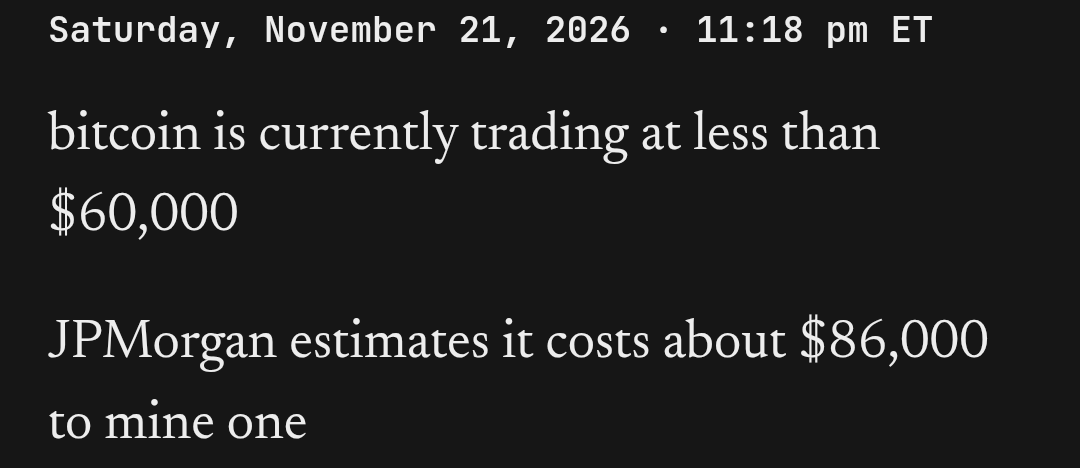
bitcoin is currently trading at less than $60,000
JPMorgan estimates it costs about $86,000 to mine one
Source: Molly White on social media.
Mining is one. This tweet is misleading, cryptocurrencies like Bitcoin are designed to work this way - the difficult of mining a coin automatically adjusts to be slightly less costly than buying a coin, giving miners a slim profit margin. Whenever the price drops some of those miners will no longer be profitable and they’ll stop mining until the difficulty adjusts again or the price goes back up.
Other network validation activities that can earn a return are staking, running masternodes for specialized networks (providing services or participating in governance), or operating mining pools. You can rent out storage capacity on decentralized storage networks or rent out spare CPU/GPU resources for distributed computing, provide services like blockchain data availability, or run other infrastructure such as indexes or RPC endpoints. Some protocols provide compensation for governance participation. You can lend it to borrowers to collect interest, provide liquidity for DeFi to get a share of trading fees, or provide liquidity to stabletokens to get return from trading fees or protocol incentives.
A lot of this is very complicated, though, so people tend not to pay as much attention to it. “Buy low sell high” is easy to understand.
It can catch some miners in a lose-lose cost situation though, because idle hardware still depreciates. If the miners borrowed money to build out the hardware and are paying interest, and expected a certain amount of operational uptime out of it, long periods of low prices can turn the whole operation unprofitable.
It’s the same economics as oil wells. A well that costs $70/barrel to operate just idles when oil prices are less than $70/barrel, but the existence of other wells that can produce at $30/barrel means that the price can sit below their break even price for a long time.
There isn’t a single uniform global cost of mining. Low prices push certain miners into unprofitable territory, which buffers the mining difficulty by causing some miners to go idle, but that just means the highest cost miners go idle first and come back online last, which might financially ruin a few miners on the expensive end of things
That’s still working as designed, though - a miner with chronically high costs relative to other miners should go out of business and stop mining. They’re evidently just not good at it.
There’s no “design” here. Individual participants make their own investment decisions on building out the servers to mine Bitcoin at scale, and then over the useful life of that hardware it mines Bitcoin when profitable and then the hardware is retired or sold for another purpose once it’s no longer profitable. They plan things out with an assumption about energy costs, Bitcoin prices, etc., and sometimes those long term projections turn out to be wrong to where they have to retire the hardware earlier than initially planned, or having a lower utilization rate over the course of its useful life, and they lose money on that.
The macro equilibriums make the system as a whole survive, but individual players can and do get wiped out from shifts in prices that break their assumptions. And sometimes it swings the other way, too, where they make windfall profits they weren’t expecting.
You said there was no design and then immediately described the design in detail. That’s exactly how it’s supposed to work.
The tweet isnt misleading, its just part of a larger article:
https://www.citationneeded.news/issue-112/
She makes it very clear how and why the miners are still mining bitcoin, even with the disparity in price. Mostly its due to them locking in electricity discounts and having the infastrucuture in place already. Their costs are not currently the average cost.
Let’s be honest here: The system as envisioned by Satoshi is a Peer-to-Peer system where individuals are providing their GPU power and not whatever Bitcoin became with an oligopoly of big companies controlling most of the hashing power by building multi-billion dollar factories. The system does work when I switch of my personal computer, but not with those big companies who have build big hashing factories
Bitcoin is doing exactly what it was designed to do, provide a way for the CIA to launder money to fund its black ops, Satoshi was a pseudonym used by a team of CIA hackers . [Citation Needed]
I was completely unaware of the ability to run nodes, or deal with storage, and the rest… Thank you, I appreciate that.
No problem. I’d advise against actually trying any of this without doing a bunch of research first, mind you. Almost everything is designed so that “passive income” is just a trickle, you need to actually know what you’re doing and actively provide some kind of service to generate more than that. Which makes sense, why pay people for doing basically nothing?
Oh, and note also that much of this doesn’t involve Bitcoin specifically. You asked about crypto, which covers a much broader range of blockchains than just Bitcoin. Bitcoin’s just the oldest and best known, it’s actually kind of obsolete these days for most of the fancy stuff.
Funny how BT is still worth at least 20 times more than Etherium and all the other useful coins. Becoming obsolete didn’t seem to hurt it’s value. Not yet at least.
Well it’s value has almost halved since 2024.
True, but the other not obsolete coins went down with it, so I wouldn’t say that’s the reason.
Yeah though I think bitcoin has been underpinning most of the other coins to some extent.
The irony of it being similar to the gold standard is pretty funny to me.
Name recognition is super valuable, I guess.
Ether alone has 1/6 the market cap of Bitcoin, though, so it’s not actually as bad as you say.