

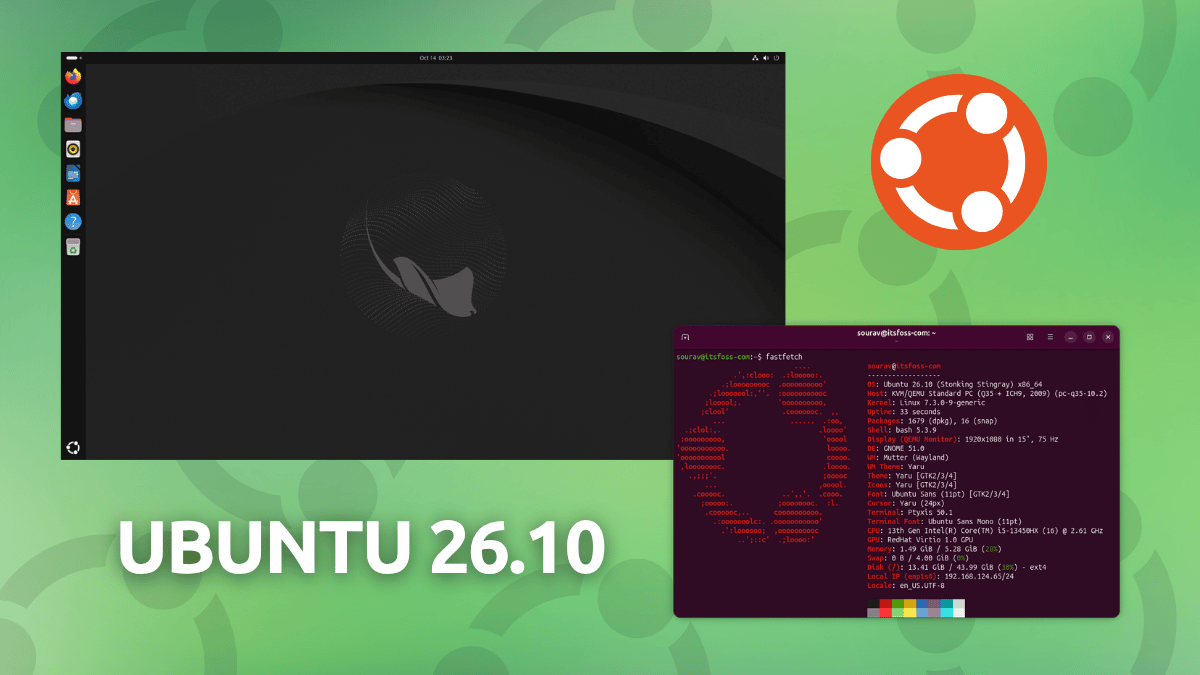
The title says that because, until now, the core utilities in Ubuntu were not fully Rust. cp, mv, and rm had stayed on the GNU versions over compatibility issues. They have since moved to the Rust-based uutils implementation, taking the distro even further in its oxidation process.
Ubuntu 26.10, codenamed “Stonking Stingray”, is an interim release, which means it brings newer software than the earlier LTS while only getting nine months of support, ending in July 2027.
Although our features roundup covered a lot of ground, there were some changes that it missed.
Ubuntu 26.10: What’s New?
Well, we start with the kernel powering this interim release, Linux 7.3, which offers support for recent Snapdragon X2 Elite laptops along with several older Snapdragon X Elite and X Plus machines from Lenovo, HP, and Acer.
Gamers will be glad to know that the first chunk of Valve engineer Natalie Vock’s VRAM overcommit work has also landed in this kernel. Games on graphics cards with too little video memory should run better, as some of the data can now be offloaded to regular system RAM.
You already know that this Linux release is shaping up to be one of the most performance-focused releases in years.
Ubuntu is also moving to the NVIDIA 615 driver series, which replaces 595 and 610 and ships open kernel modules only, supporting Turing and newer GPUs.
The rustification we talked about earlier also extends to OpenPGP, where Sequoia PGP, a Rust-based implementation built by former GnuPG developers, has landed in the main archive. Its sq and sqv tools now sit alongside GnuPG’s gpg and gpgv.
For the desktop environment, Ubuntu 26.10 has GNOME 51, with its range of upgrades such as a fingerprint manager in the Users panel, DNS search domains in the Network settings, and a count badge in Files when you drag multiple items.
There’s also the Ubuntu Tiling Assistant that shows a Windows-11-like interface for the built-in snappable window layouts.
If you were hoping for a redesigned installer and first-boot onboarding flow, those are planned to come for the next long-term support release, Ubuntu 28.04 LTS.
Other Changes & Improvements
These are some of the other notable changes in this release:
OpenSSL 4 brings Encrypted Client Hello (ECH) and better QUIC support.
TPM-backed full-disk encryption now works without a hardware root of trust if a PIN or passphrase is set.
The RISC-V platform gets official RVA23 support for the SpacemiT K3 boards and SiFive's BigSky platform.
Twelve new wallpapers that were picked across the Mascot, Photography, and Digital/Abstract categories.
The toolchain upgrades consist of GCC 15.2.0, LLVM 22.1.8, Python 3.14.7, Rust 1.97.1, Go 1.27, and OpenJDK 25.0.4.
Download Ubuntu 26.10
ISOs for this interim release are available for AMD64, ARM64, RISC-V, and others from the official website; go for the “Desktop” ISOs if you are a regular user. Specific flavors like Server, Netboot, and WSL can be fetched from the releases portal.
I was wondering why people here are so hyped about coreutils. Turns out that it’s a Linux community, not a programming one. And it shows
Generally I think when Ubuntu makes big moves, they’re pretty bad, but these rust reimplementations are actually pretty good. Good job, Canonical.
What part of changing working, tested and very stable utilities with semi-compatible unstable ones is pretty good?
Because rust is inherently memory safe, so these utilities will be less likely to have hidden memory errors that could cause security issues.
So the change brings real incompatibility in excange for potential safety?
If the tools are actually incompatible, you can always go back to the old tools. They’re in another package.
There are probably edge cases and you might not know about them until you actually run into them by running a script or similar but then it is to late as people dont want things to break. There is 30 years of testing, and expected behavior, behind on what we have today.
Yeah man, we should never change anything.
“I’m against change!”
Great, then don’t change. No one is forcing you to. Just let others do their thing.
Should we change for the sake of change without any tangible benfits and obvious disadvantages on supposedly enterprise grade distros?
is this the one that AI has found 18 year old bugs and inconsistencies in?
replacing this C shit show guarantees safety and using new fuzzers to ensure correctness and fix bugs in the gnu version is a bonus
how is your non systemd distro going for you? have you heard of gui’s? nothing like the old clickety clack of the vt100s eh?