

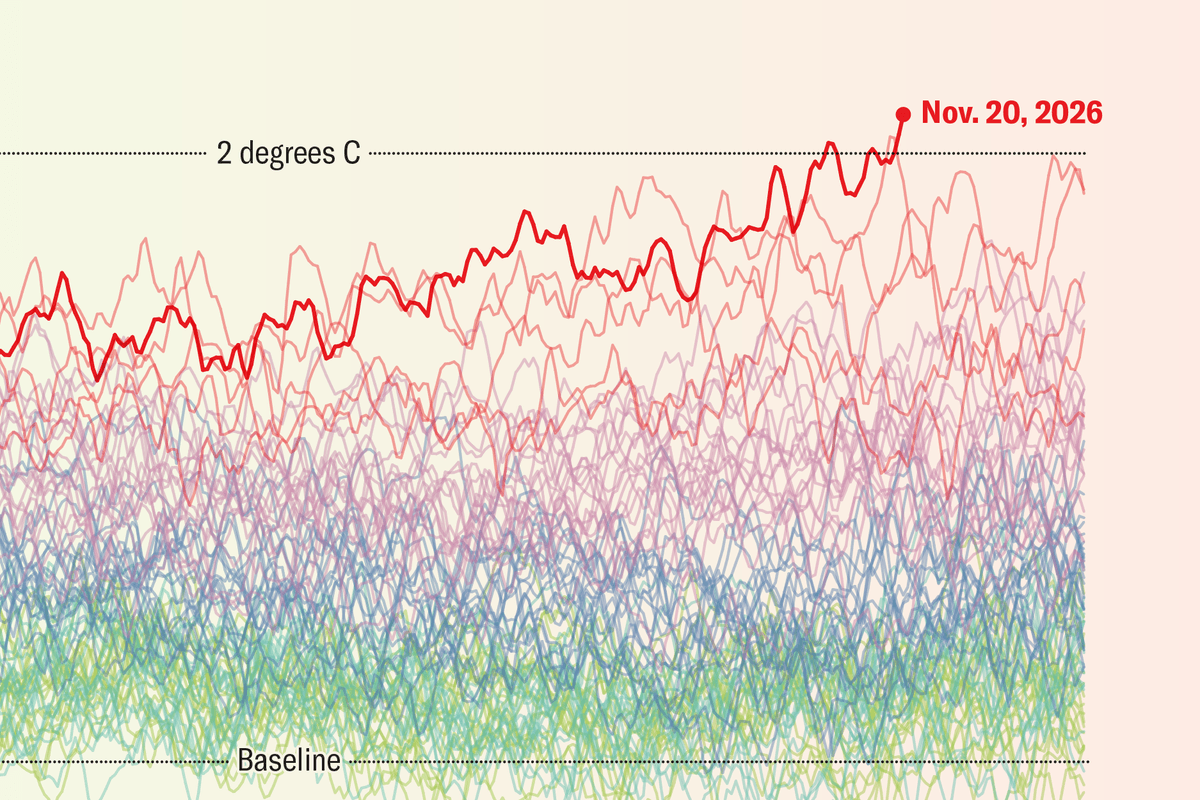
Earth just saw the most anomalously hot day ever measured on the planet. According to preliminary data from the Europe-based Copernicus Climate Change Service (C3S), Friday, November 20, 2026, was 2.12 degrees Celsius higher than the preindustrial average—or the time before humans began heating up Earth by burning fossil fuels.
The record stems from a combination of long-term, human-driven climate change and a blockbuster El Niño that is likely the strongest in the past 1,000 years. It comes as international negotiations at the COP31 climate summit have fallen apart, with no global agreement on how to rein in global warming.
Eh, the scale of the horizontal axis on the graph varies by many orders of magnitude—you can’t really judge from it whether most arbitrary 10k year stretches would be similarly consistent if we zoomed in far enough.
Maybe I used the wrong word, I meant more like it was more steady than over general human history. Thanks to the climate being stable, humans were able to farm and achieve what we have today, if it was for example 20000 years ago, we wouldn’t have be able to. Here’s a more linear graph.
Yes, that is also why we need to everything in our power to keep the climate from changing too much
Exactly. You can even see several slices covering millions of years within a smaller range than the “anomalous last 10k”. The blue final part is also seemingly stretching into the previous period with apparently 200k years of “consistent” temps.